Somehow I ended up doing a bunch of pre-20th century group reads lately. Out of all of them, this is by far the book I like the best. Dracula is wonderfully atmospheric but also painfully racist; Moby Dick's best parts are absolutely gorgeous but it could have done with a massive edit, also racism; I got bored of Don Quixote after a while. But this one is wonderfully and tightly written, and I'm reasonably confident that everything obnoxious in it is intentionally so (in short: oh, Victor is so perfectly hateable).
Reviews and Comments
I am an enthusiastic member of #SFFBookClub so a lot of what I'm reading is suggestions from there.
Profile pic by @anthracite@dragon.style
This link opens in a pop-up window
el dang commented on Frankenstein or the Modern Prometheus by Mary Shelley
Somehow I ended up doing a bunch of pre-20th century group reads lately. Out of all of them, this is by far the book I like the best. Dracula is wonderfully atmospheric but also painfully racist; Moby Dick's best parts are absolutely gorgeous but it could have done with a massive edit, also racism; I got bored of Don Quixote after a while. But this one is wonderfully and tightly written, and I'm reasonably confident that everything obnoxious in it is intentionally so (in short: oh, Victor is so perfectly hateable).
Historical note: Jardine & Matheson were real people and played very much the same role in real history that they are playing when they show up in this book. Their company, now just "Jardine Matheson", still exists, still has a large footprint in Hong Kong, and did very well out of Britain's abuse of China. If you don't know the history and don't want spoilers then I'd wait until a couple of chapters after they're introduced to look them up. Though I'm also assuming that somewhere after where I've reached, the book must diverge from the real history.
Karl Gützlaff was also a real person whose attitudes seem to be faithfully represented in the book, though I don't know enough about him to know how historically accurate his actions in the book are. #SFFBookClub
Historical note: Jardine & Matheson were real people and played very much the same role in real history that they are playing when they show up in this book. Their company, now just "Jardine Matheson", still exists, still has a large footprint in Hong Kong, and did very well out of Britain's abuse of China. If you don't know the history and don't want spoilers then I'd wait until a couple of chapters after they're introduced to look them up. Though I'm also assuming that somewhere after where I've reached, the book must diverge from the real history.
Karl Gützlaff was also a real person whose attitudes seem to be faithfully represented in the book, though I don't know enough about him to know how historically accurate his actions in the book are. #SFFBookClub
Content warning ch15 spoiler
Yesterday I read the scene in which Professor Lovell browbeats Robin into pretending contrition and giving up a scrap of information about Hermes. A different part of it is haunting me: the way Lovell never engages with a single moral claim Robin makes, just mocks and dismisses them out of hand. That part of the conversation, I've had personally with so many relatives and the occasional coworker / fellow student. And I keep reading reports of political and media figures doing the same - Lovell might as well have just said "woke" with that sneer they all do.
None of which is a criticism of the book! It was a painfully well-observed scene. #SFFBookClub
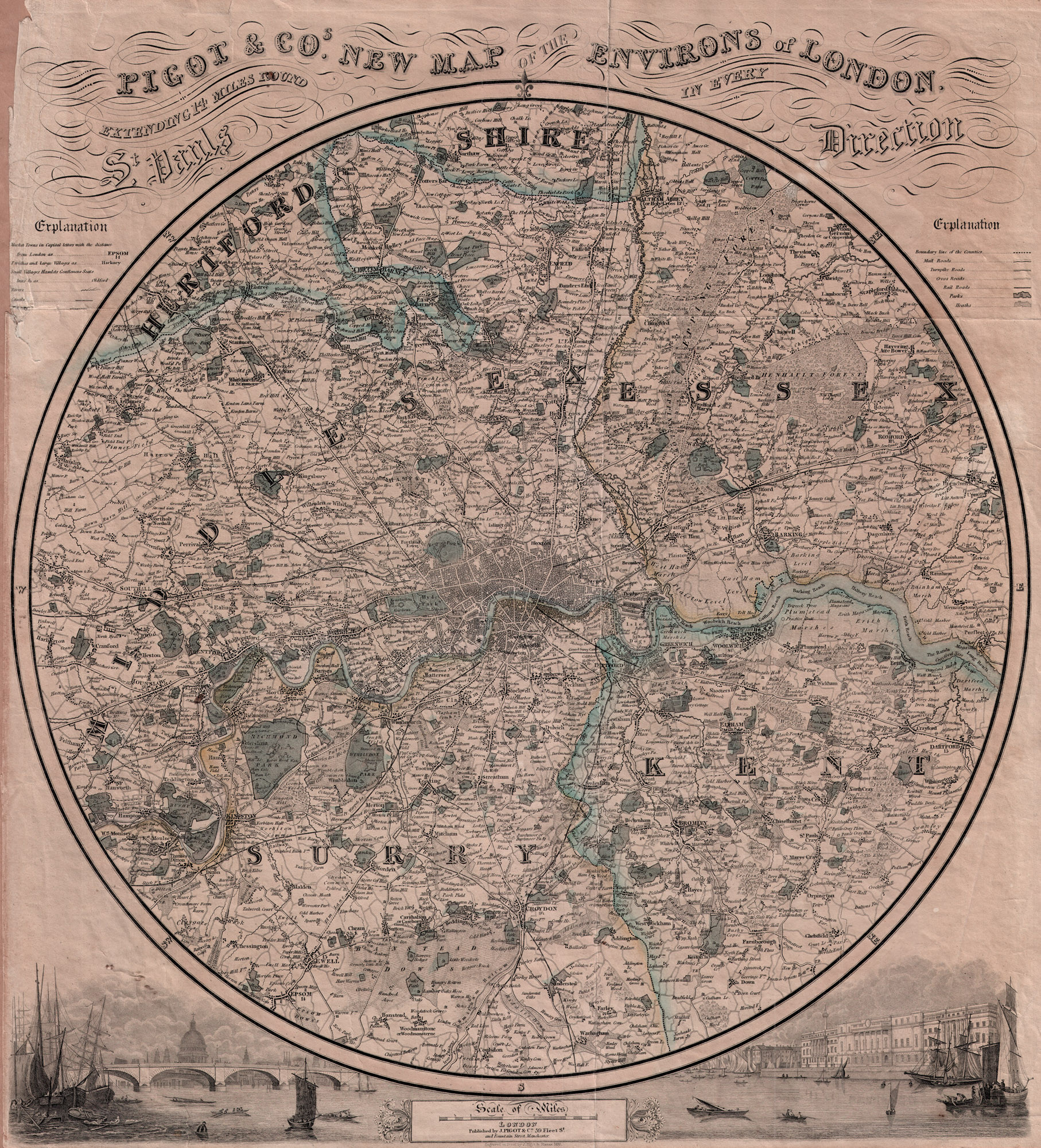
London at the time of... approximately chapter 15: sciencemastodon.com/@oldmapgallery/111931878489659575 cdn.masto.host/sciencemastodoncom/media_attachments/files/111/931/866/556/732/629/original/197a25046f337b05.jpg
among other things, it really underscores how separate Hampstead would have felt back then.
Content warning ch12, non spoiler
I'm enjoying how much Kuang ties the fantasy world of the book to the real world unrest that was happening at the same time, and how timeless the attitudes of the people fully bought into the system are. #SFFBookClub
el dang reviewed The Kingdom of Copper by S. A. Chakraborty (The Daevabad Trilogy, #2)
moar Daevabad!
5 stars
Book 2 in a series, and a wonderful fleshing out of things that were introduced in City of Brass. The politics get more complicated and feel more real as a result, the focus characters get more developed, and the city feels more alive. It feels like such a sharp analysis of the ways resentments and conflicts get stuck and self-feeding that I kept seeing real-world stories reflected in it. But it's never as narrow as an allegory for any one thing in the real world, it's much more an exploration of the whole type of thing.
It does have weaknesses: never getting Ghassan's perspective lets him feel like a cartoon villain, and never getting Muntadhir's makes his growth feel lurching and unpredictable... which in fairness it probably would have done to people around him too. And where the ending of City of Brass deftly managed to stand on its …
Book 2 in a series, and a wonderful fleshing out of things that were introduced in City of Brass. The politics get more complicated and feel more real as a result, the focus characters get more developed, and the city feels more alive. It feels like such a sharp analysis of the ways resentments and conflicts get stuck and self-feeding that I kept seeing real-world stories reflected in it. But it's never as narrow as an allegory for any one thing in the real world, it's much more an exploration of the whole type of thing.
It does have weaknesses: never getting Ghassan's perspective lets him feel like a cartoon villain, and never getting Muntadhir's makes his growth feel lurching and unpredictable... which in fairness it probably would have done to people around him too. And where the ending of City of Brass deftly managed to stand on its own at the same time as leaving a clear opening for a sequel, the end of this one doesn't stand on its own at all.
I'm very glad that the teaser for Empire of Gold makes clear that we'll get some chapters from Manizheh's perspective, and I hope it also gives Zaynab a bit more space, since she feels a bit like a plot mechanism so far. But I couldn't put this volume down and it took some self control to not launch directly into the next.
Content warning minor spoilers for book 1 / the first 4 chapters
I'm thoroughly enjoying this book so far, including among other things the descriptions of Oxford through the eyes of some new students. It's clear that Kuang has a lot of affection for the place even as she's setting the story up to be very sharply critical of it in important ways. And that's striking a very personal chord with me.
I interviewed at Oxford as a potential undergrad, and didn't get in. It was the one university I applied to that required an interview, and even though the interview itself was frustrating [I seemed to be evaluated on prior subject knowledge, for a subject they advertised as not needing prior background to study], the 3 days in Oxford in an autumnal fog around it were lovely. Looking back I'm reasonably confident that I was better off studying elsewhere, but every now and then I do get some longing for the place because it is so beautiful, and it is possible to fall for the illusion it has of itself as a town-sized temple of pure learning.
I think Robin and Rami's 3 days of freedom before term starts managed to capture a lot of that feeling. It's already clear the place isn't going to be as good for Robin as he thinks, but oh it's such a beautiful place it's easy to be charmed by it.
el dang reviewed How High We Go in the Dark by Sequoia Nagamatsu
How High We Go in the Dark
4 stars
A very emotional and structurally interesting book - somewhere between a set of short stories and a set of chapters with very varied styles and points of view.
I loved the ways the stories were connected to each other, and the best of them were absolutely heartrending pictures of grief, fear, and mourning. Many of them did live on in my mind for some time afterwards. But towards the end I felt like some of the broader attempts to pull it all together in one arc didn't quite land for me.
A very emotional and structurally interesting book - somewhere between a set of short stories and a set of chapters with very varied styles and points of view.
I loved the ways the stories were connected to each other, and the best of them were absolutely heartrending pictures of grief, fear, and mourning. Many of them did live on in my mind for some time afterwards. But towards the end I felt like some of the broader attempts to pull it all together in one arc didn't quite land for me.
#SFFBookClub February pick.
el dang commented on The Kingdom of Copper by S. A. Chakraborty (The Daevabad Trilogy, #2)
CW for this book: a big piece of what it's about is stuck conflicts and deeply ingrained oppression, and the ways in which mutual fear / the fears of the people currently on top keep them stuck with horrifying consequences. Reading it right now I keep thinking about Palestine, which I think is partly intentional but there are also strong echoes of many other things. I'm about 2/3 of the way through and I think it's excellent, just also a very grim read.
To some extent this applies to City Of Brass too, but this volume paints a lot more of the history of the trilogy's world and goes a lot harder on the political themes.
CW for this book: a big piece of what it's about is stuck conflicts and deeply ingrained oppression, and the ways in which mutual fear / the fears of the people currently on top keep them stuck with horrifying consequences. Reading it right now I keep thinking about Palestine, which I think is partly intentional but there are also strong echoes of many other things. I'm about 2/3 of the way through and I think it's excellent, just also a very grim read.
To some extent this applies to City Of Brass too, but this volume paints a lot more of the history of the trilogy's world and goes a lot harder on the political themes.
el dang wants to read Iron Widow by Xiran Jay Zhao (Iron Widow #1)
Adding this to the #SFFBookClub poll; go to weirder.earth/@eldang/111807462468721007 to vote
el dang commented on How High We Go in the Dark by Sequoia Nagamatsu
Chapter 3: I see now that characters from one story do show up in others, so the book overall will get to have character arcs not just a zoomed-out plot one. Makes me even more curious how much the stories have been reworked between individual publication and collecting into book form.
el dang commented on How High We Go in the Dark by Sequoia Nagamatsu
Content warning Chapter 2 spoiler; CW for plague
At first, I thought the plague business was a bit too much of a neat topical tie-in. But then I noticed in the front matter that many of the chapters are adapted from previously published short stories, and the original version of ch2 was published in 2013. So at least the outline of the plague predates COVID by years.
I'm curious whether the line about disagreement whether the virus was airborne was added in the editing for the book, because if not then that detail is astonishingly prescient.
Either way, I find myself wanting to know what happens to Skip and Dorrie after the events of this chapter. I can't tell yet if the book will pick them up again later or if each chapter's going to be a totally isolated vignette within the overall setting.