Daniel reviewed The Three-Body Problem by Cixin Liu (Three-Body Trilogy, #1)
How to hack a proton
3 stars
This was a little too weird for me and I can’t say I really bought the premise of the story fully…
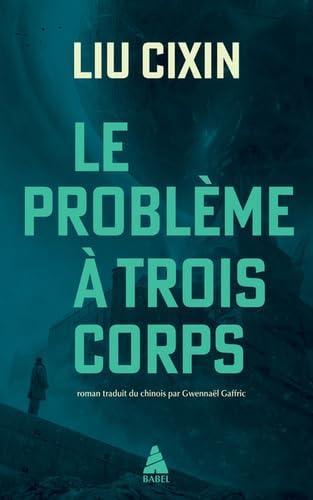
Paperback, 512 pages
français language
Published Feb. 14, 2024 by Babel.
En pleine Révolution culturelle, le pouvoir chinois construit la base militaire secrète de Côte Rouge, censée abriter le développement d’une arme de grand calibre. Ye Wenjie, une jeune astrophysicienne en cours de “rééducation”, intègre l’équipe de recherche. Là, elle découvre un système de télétransmissions dirigé vers l’espace, destiné à établir un contact avec les civilisations extraterrestres… Hugo 2015 du meilleur roman, “Le Problème à trois corps” est le premier volume d’une trilogie devenue culte, adaptée pour Netflix en 2024 par les créateurs de “Game of Thrones”.
En pleine Révolution culturelle, le pouvoir chinois construit la base militaire secrète de Côte Rouge, censée abriter le développement d’une arme de grand calibre. Ye Wenjie, une jeune astrophysicienne en cours de “rééducation”, intègre l’équipe de recherche. Là, elle découvre un système de télétransmissions dirigé vers l’espace, destiné à établir un contact avec les civilisations extraterrestres… Hugo 2015 du meilleur roman, “Le Problème à trois corps” est le premier volume d’une trilogie devenue culte, adaptée pour Netflix en 2024 par les créateurs de “Game of Thrones”.
This was a little too weird for me and I can’t say I really bought the premise of the story fully…
Content warning This book is intensely political.
Everyone loves this, but I can't understand why nobody seems to be put off, or at least puzzled, but the way that every human individual or organization in the book is just relentlessly awful, ranging from suicidal to genocidal, and everything in-between, without respite.
Most of them, given any chance at all, are trying hard to selfishly save their own skins, with not a moment's regard for the fact that their plans will immediately doom the rest of the human race. Those not intent on self preservation at any cost are instead committed to bitter nihilism, such as the ultimate eco-terrorists, who feel that to save the Earth's biosphere they must collaborate with alien forces to bring about humanity's defeat, and likely annihilation.
These characters and groups are not depicted as outliers. They represent the human race in its entirety. The only thing that holds back this tide of destructive behavior is the government, who keeps everyone in line.
I can't tell how much of this bizarrely one-sided depiction of humanity is a deliberate choice by the author, versus simply being an unplanned exposure of their worldview, shaped as it is by their native Chinese immersion in authoritarianism. Does that form a subconscious backdrop to everything they wrote here, or are they consciously making a deliberate point that strong government is absolutely necessary?
The author Liu Cixin has since gone on record in support of the Chinese government's internment of Muslim Uighurs in Xinjiang. There, people have been rounded up, because of their ethnicity, into over 400 internment camps. The camps administer cultural and religious re-education, forced labor, involuntary sterilization and abortion. This is something Liu Cixin is openly in favor of.
It makes my skin crawl to read that, and then carry on blithely with this story book of theirs, which seems to be an unapologetic justification for an authoritarian government's impositions on its populate. I did finish it, but have no desire to read the sequels - and not just because I don't agree with the politics. I genuinely found the behavior of all the characters to be intrusively bewildering, demented and incessantly frustrating.
Spannend aufgebaut mit verschiedenen Handlungssträngen, die sich irgendwann zusammenfügen. Technische / physikalische Grundprinzipien auch für mich als Laien verständlich dargestellt. Und die Frage nach dem "First Contact" mit all ihren Implikationen wurde toll beackert. Zusätzlich erfährt von noch etwas über die jüngere chinesische Geschichte.
Spannend aufgebaut mit verschiedenen Handlungssträngen, die sich irgendwann zusammenfügen. Technische / physikalische Grundprinzipien auch für mich als Laien verständlich dargestellt. Und die Frage nach dem "First Contact" mit all ihren Implikationen wurde toll beackert. Zusätzlich erfährt von noch etwas über die jüngere chinesische Geschichte.
The first few chapters had me darting to and from Wikipedia to help add some context to a story that is deeply set in the Chinese Cultural Revolution. It',s a triviality to call the story complex, a mystery than unfolds through the book. Be warned this is the first in a trilogy and a very much sets itself up this way, which was a little frustrating in the last few chapters.
The first few chapters had me darting to and from Wikipedia to help add some context to a story that is deeply set in the Chinese Cultural Revolution. It',s a triviality to call the story complex, a mystery than unfolds through the book. Be warned this is the first in a trilogy and a very much sets itself up this way, which was a little frustrating in the last few chapters.
Es el primero de una trilogía. Me ha gustado, aunque hay algunas cosas "científicas" que me han parecido muy simplonas. De cualquier forma, estoy leyendo el segundo, y creo que también leeré el tercero. Lo recomiendo.
Es el primero de una trilogía. Me ha gustado, aunque hay algunas cosas "científicas" que me han parecido muy simplonas. De cualquier forma, estoy leyendo el segundo, y creo que también leeré el tercero. Lo recomiendo.
A good hard fiction novel that explores the question of making first contact. It's a quick read that has decent character development, a smooth flowing plot, and asks deep philosophical science questions.
A good hard fiction novel that explores the question of making first contact. It's a quick read that has decent character development, a smooth flowing plot, and asks deep philosophical science questions.
Ich hab innerhalb von zwei Tagen "Die Drei Sonnen" von Cixin Liu gelesen. Das hatte ich schon sehr lange auf meiner Liste und erfreulicherweise waren alle drei Bände der Trilogie in der Stadtbücherei vorrätig.
Die knapp 550 Seiten haben sich schnell und angenehm gelesen. Das Meisterwerkgefühl bliebt bei mir jedoch leider aus.
Die Geschichte ist nett, aber jetzt nichts neues, vieles wirkt eher konstruiert und anstatt Entdeckung wird eher präsentiert.
Ich hab innerhalb von zwei Tagen "Die Drei Sonnen" von Cixin Liu gelesen. Das hatte ich schon sehr lange auf meiner Liste und erfreulicherweise waren alle drei Bände der Trilogie in der Stadtbücherei vorrätig.
Die knapp 550 Seiten haben sich schnell und angenehm gelesen. Das Meisterwerkgefühl bliebt bei mir jedoch leider aus.
Die Geschichte ist nett, aber jetzt nichts neues, vieles wirkt eher konstruiert und anstatt Entdeckung wird eher präsentiert.
Empecé con muchas ganas este ganador del Premio Hugo de 2015. Ciencia ficción "hard", de una cultura un tanto exótica para mí como la china, y con aplauso unánime de la crítica, prometía mucho. Y no es que sea una mala lectura ni mucho menos, pero me ha acabado decepcionando bastante.
Se dice que el autor está muy influido por Asimov, Clarke y similares, y la verdad es que sí: la trama contiene muchos elementos que podían haber sido originales en los años 60, pero que desde luego hoy en día no lo son, al menos en Occidente. El personaje principal es bastante plano; los secundarios, que tenían mimbres para ser interesantes, acaban resultando estereotípicos; el hecho de que la novela acabe en un "continuará" (es el primer libro de una trilogía) no ayuda tampoco a la redondez de la trama.
En otros aspectos donde se ven influencias de otros …
Empecé con muchas ganas este ganador del Premio Hugo de 2015. Ciencia ficción "hard", de una cultura un tanto exótica para mí como la china, y con aplauso unánime de la crítica, prometía mucho. Y no es que sea una mala lectura ni mucho menos, pero me ha acabado decepcionando bastante.
Se dice que el autor está muy influido por Asimov, Clarke y similares, y la verdad es que sí: la trama contiene muchos elementos que podían haber sido originales en los años 60, pero que desde luego hoy en día no lo son, al menos en Occidente. El personaje principal es bastante plano; los secundarios, que tenían mimbres para ser interesantes, acaban resultando estereotípicos; el hecho de que la novela acabe en un "continuará" (es el primer libro de una trilogía) no ayuda tampoco a la redondez de la trama.
En otros aspectos donde se ven influencias de otros autores, los extraterrestres, lejanos y enigmáticos pero a la vez muy humanos, me recuerdan poderosamente a los de Los Propios Dioses; el juego de realidad virtual no puede menos de sonarnos a Ender... Pero todo ello con menos fuerza que las referencias originales.
Curiosamente, donde me parece que el libro se vuelve más vivo y brillante es en sus regresiones sobre China, la Revolución Cultural y su evolución posterior. Quizás es simplemente por mi desconocimiento sobre el tema, pero los capítulos centrados en ese tema se me hicieron mucho más interesantes.
El libro se lee bien, entretiene y es de lectura ágil, pero esperaba algo más. No sé si continuaré con los otros dos libros de la trilogía, tocará pensarlo.
Wow. In the classic way of much great sci-fi, this book uses a couple of outlandish inventions to explore the human society of its time. The inventions themselves are interesting, but their reflections in earth society much more so.
This is partly a book about China--particularly about how the horrors of the Cultural Revolution still shape survivors even now--but it also has a lot to say about globalised culture, especially the divisions within the environmental movement.
The first 2 or 3 chapters are set in the Cultural Revolution and are absolutely harrowing. If you have a hard time getting through them, it's worth knowing that the book doesn't stay that dark.
Wow. In the classic way of much great sci-fi, this book uses a couple of outlandish inventions to explore the human society of its time. The inventions themselves are interesting, but their reflections in earth society much more so.
This is partly a book about China--particularly about how the horrors of the Cultural Revolution still shape survivors even now--but it also has a lot to say about globalised culture, especially the divisions within the environmental movement.
The first 2 or 3 chapters are set in the Cultural Revolution and are absolutely harrowing. If you have a hard time getting through them, it's worth knowing that the book doesn't stay that dark.