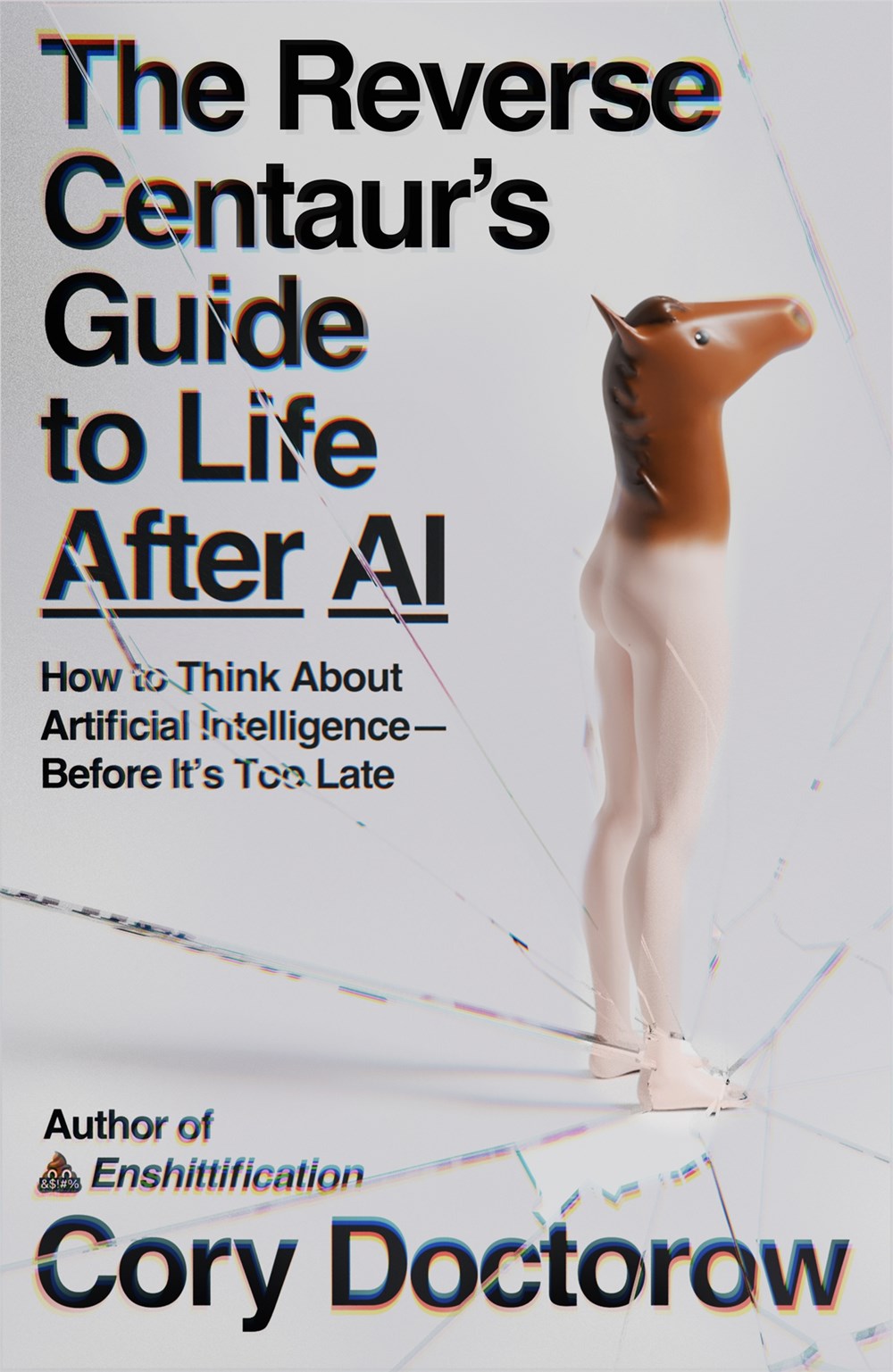
A centaur is a person whose work is assisted by technology, a worker whose tools make them happier and more productive. A reverse centaur, on the other hand, is a worker pressed into service to technology, a person pushed beyond human endurance to work on a machine’s terms. Think of a warehouse worker made to work without food or bathroom breaks, or a programmer made to crank out impossible amounts of code.
There is, to Cory Doctorow, nothing inevitable about the story of AI, about who or what will play which roles. He thinks the technology is useful, even exciting. But AI has arrived surrounded by unprecedented hype, preordained as a world-changing disruption that defies all rational evaluation. Doctorow seeks to puncture that bubble before it’s too late, to help us understand the technology not just for what it actually does—though that, of course, is important—but who it does …
A centaur is a person whose work is assisted by technology, a worker whose tools make them happier and more productive. A reverse centaur, on the other hand, is a worker pressed into service to technology, a person pushed beyond human endurance to work on a machine’s terms. Think of a warehouse worker made to work without food or bathroom breaks, or a programmer made to crank out impossible amounts of code.
There is, to Cory Doctorow, nothing inevitable about the story of AI, about who or what will play which roles. He thinks the technology is useful, even exciting. But AI has arrived surrounded by unprecedented hype, preordained as a world-changing disruption that defies all rational evaluation. Doctorow seeks to puncture that bubble before it’s too late, to help us understand the technology not just for what it actually does—though that, of course, is important—but who it does it to and who it does it for.
From that point of view, the story of AI is indeed dramatic and unprecedented, though it is not the version of the story we have been commonly told. In The Reverse Centaur’s Guide to Life After AI—as he did so successfully in Enshittification—Doctorow recounts both how we found ourselves in this situation and how we can get through it, to a life “after” AI in which the tools work for us, not the other way around.
I think the most useful thing here isn’t about AI at all: it’s the concise formulation of the idea that all technology supports power dynamics. “The most important thing about the gadget isn’t what it does, it’s who it does it for and who it does it to.” Yes, this applies to AI, but it’s a lens that should be used with all technology.
I found this book useful in its clarity. I don’t know that it’ll change anybody’s mind, but for people already prone to be skeptical of big tech’s AI obsession, it provides some useful framing, facts, and arguments.
It’s also a fun read. Which, given the subject matter, is not a given. I breezed through it; you might too.
As a tech worker who uses LLMs skeptically, this gave me clarity and a little needed repetition that are helping me break some bad habits in my reactions to all the relentless hype I have to work around. As always I learned some helpful history and appreciate a little dark humor in the face of an otherwise overwhelming menace.