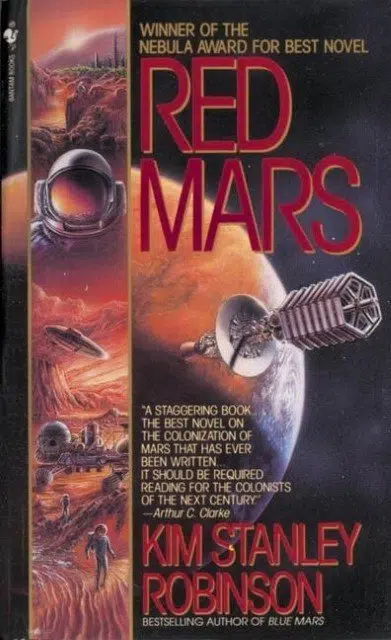
In his most ambitious project to date, award-winning author Kim Stanley Robinson utilizes years of research & cutting-edge science in the 1st of a trilogy chronicling the colonization of Mars:
For eons, sandstorms have swept the desolate landscape. For centuries, Mars has beckoned humans to conquer its hostile climate. Now, in 2026, a group of 100 colonists is about to fulfill that destiny.
John Boone, Maya Toitavna, Frank Chalmers & Arkady Bogdanov lead a terraforming mission. For some, Mars will become a passion driving them to daring acts of courage & madness. For others it offers an opportunity to strip the planet of its riches. For the genetic alchemists, it presents a chance to create a biomedical miracle, a breakthrough that could change all we know about life & death. The colonists orbit giant satellite mirrors to reflect light to the surface. Black dust sprinkled on the polar …
In his most ambitious project to date, award-winning author Kim Stanley Robinson utilizes years of research & cutting-edge science in the 1st of a trilogy chronicling the colonization of Mars:
For eons, sandstorms have swept the desolate landscape. For centuries, Mars has beckoned humans to conquer its hostile climate. Now, in 2026, a group of 100 colonists is about to fulfill that destiny.
John Boone, Maya Toitavna, Frank Chalmers & Arkady Bogdanov lead a terraforming mission. For some, Mars will become a passion driving them to daring acts of courage & madness. For others it offers an opportunity to strip the planet of its riches. For the genetic alchemists, it presents a chance to create a biomedical miracle, a breakthrough that could change all we know about life & death. The colonists orbit giant satellite mirrors to reflect light to the surface. Black dust sprinkled on the polar caps will capture warmth. Massive tunnels, kilometers deep, will be drilled into the mantle to create stupendous vents of hot gases. Against this backdrop of epic upheaval, rivalries, loves & friendships will form & fall to pieces--for there are those who will fight to the death to prevent Mars from ever being changed.
Brilliantly imagined, breathtaking in scope & ingenuity, Red Mars is an epic scientific saga, chronicling the next step in evolution, creating a world in its entirety. It shows a future, with both glory & tarnish, that awes with complexity & inspires with vision.
С одной стороны, твердая НФ, по-настоящему научная. С другой — левацкая агитка, приправленная беспорядочными связями. Лучше бы автор оставил свои политические и сексуальные предпочтения при себе.
If Robinson were better at writing characters, this could have been a book I'd really love. It has an engaging sweep of a plot, it makes Mars feel more real and reachable than anything else I've read, and all the politics & ecology running through it feel at least possible, mostly plausible. But the characters are so painfully thin! Each is either a pure vessel for an ideology (and at times their arguments made me feel like I was reading the lefty Ayn Rand), or a nation profession combo caricature. By far my favourite parts of the book are the long sections in which Mars itself is the main character, because in those this flaw recedes. And the worst parts are the interpersonal drama because I could so readily slip into dropping the names altogether and just reading it as "Japanese gardener talks to Russian engineer", and so on.
Overall …
If Robinson were better at writing characters, this could have been a book I'd really love. It has an engaging sweep of a plot, it makes Mars feel more real and reachable than anything else I've read, and all the politics & ecology running through it feel at least possible, mostly plausible. But the characters are so painfully thin! Each is either a pure vessel for an ideology (and at times their arguments made me feel like I was reading the lefty Ayn Rand), or a nation profession combo caricature. By far my favourite parts of the book are the long sections in which Mars itself is the main character, because in those this flaw recedes. And the worst parts are the interpersonal drama because I could so readily slip into dropping the names altogether and just reading it as "Japanese gardener talks to Russian engineer", and so on.
Overall I enjoyed the book enough to keep reading, but found it frustrating enough that I went and read the synopses of the other two in the trilogy because I can't see myself getting around to reading the actual books. The strengths of it left me wanting to hear speculative non-fiction from Robinson, but his weaknesses as a writer of fiction undermined this book pretty badly for me.