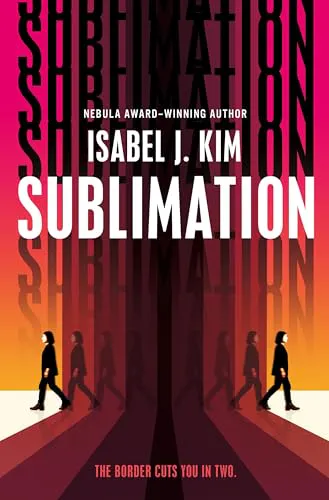
Crossing a border creates an instance. Creating a border manifests the capability for instances.
Isabel J. Kim's Sublimation is a huge recommendation from me. It's about nostalgia, borders, and forks in our lives. The plot hook in this story is that crossing a border can leave a copy of yourself who stays behind. In this world, it's a natural phenomenon caused by the psychological effect of leaving a place you can't return.
Is there a word for a genre that's somewhere between a story about coming of age and a story about a middle aged crisis? If so, this is it: twenty year olds discovering what they want out of life, who they are, and confronting some of their childhood and family trauma.
Sublimation is also a novelization of the incredible short story Homecoming is Just Another Word for the Sublimation of the Self; the opening section of the novel and the short story are very close to each other. The novel also shares the writing style of historical and cultural asides interjected into a much more personal tale. I appreciate that the novel also introduces a pair of additional viewpoints that are instances of the same person. Although, it also makes the wild choice that both points of view use second person pronouns in their narration. I could argue a fifth season-esque textual reason for this choice, but mostly just mentioning it.
Unsurprisingly, a novel about borders is one that leans on plot points about immigration, H1Bs, threats of ICE, and government control. In a plot sense, it's also against pushing back against that control from government and tech over the choices that people can make. I think the resolution of the technology half of the plot felt a bit weak to me, but the personal half of the final section of the book is so strong. I love how Soyoung's grandfather's house is such a touch point, and the resolution for the characters just resonates so well.
Instances having to work together is a staple of modern media, although the trope only became codified outside of folktalk and myth after the advent of the rail system in the western world.
Apologies for the digression, but one refreshing part of this novel is how integrated instancing is into the world.
There's so many delicious digressions about how the world works. There's discussions about how young people can instance. I love the academic analysis around Odysseus instancing but Telemachus (maybe) not. America's history is rewritten to be about accepting instanced immigrants. I especially love the rewriting of other myths, other stories, and webnovel and telenovela tropes around instancing.