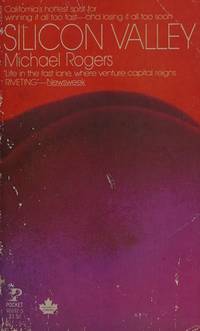

Jim Brown reviewed Silicon Valley by Michael Rogers
Silicon Valley in 1982: "We're always going to need plumbers."
I found this in a used bookstore with a label on it that said "truly scary." I had never heard of this book. What a find.
Published in 1982, this book reminds you that Silicon Valley's history of depravity runs deep. A computer company is developing Ultrachip as a hail mary to save the company, and they organize a Turing Test of the SOCRATES artificial intelligence program to show off what the chip can do. There's some schlock here, but it's definitely worth a read both in terms of being a quick fun read and (maybe more importantly) as a historical document.
Lots of great stuff in here, but I especially appreciated that the book frames the central constraint for AI as a hardware issue, something we are of course living with today in a more intense way. Also great stuff in here about labor...very hard to believe …
I found this in a used bookstore with a label on it that said "truly scary." I had never heard of this book. What a find.
Published in 1982, this book reminds you that Silicon Valley's history of depravity runs deep. A computer company is developing Ultrachip as a hail mary to save the company, and they organize a Turing Test of the SOCRATES artificial intelligence program to show off what the chip can do. There's some schlock here, but it's definitely worth a read both in terms of being a quick fun read and (maybe more importantly) as a historical document.
Lots of great stuff in here, but I especially appreciated that the book frames the central constraint for AI as a hardware issue, something we are of course living with today in a more intense way. Also great stuff in here about labor...very hard to believe this was written in the 70s/80s. Here's an exchange between a Stanford computer science professor and a New York Times journalist:
"Tomasso paused for a second and leaned back, gazing down at the gray terminal atop his desk. 'I remember,' he said, 'about five years ago, I was at some technical conference, where I met a consultant who works for different computer firms. And she was telling entry-level programmers that they'd be better off learning a trade.'
'I don't follow,' Maralee said.
Tomasso spread his hands wide. 'Which would you rather do? Hire some good engineers once, to design a smart system that basically operates in natural language, or else keep paying overpriced programmers forever?'
Maralee frowned. 'So where do the programmers go?'
Tomasso shrugged. 'I'm no sociologist. But I suppose they either get more sophisticated at what they do or' - he raised his hands again - 'they learn a trade. Computers or not,' he said with a slight smile, 'we're always going to need plumbers.'" (94-95)