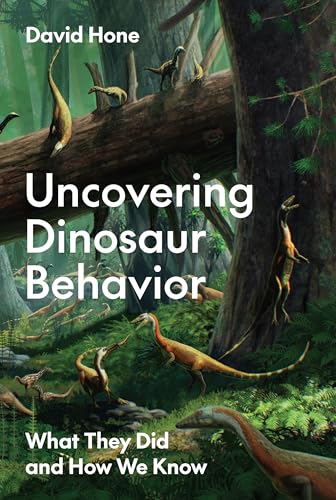

Soh Kam Yung reviewed Uncovering Dinosaur Behavior by David Hone
An interesting book on the possible behaviour of dinosaurs.
4 stars
A fascinating book that looks at what fossils and current animal behaviours can tell us about the behaviour of non-avian dinosaurs. While there have been speculative depictions of dinosaurs behaving in certain ways, the author looks at what the fossils evidence is for such behaviours. In some cases, it is quite probable: but in others, the evidence is equivocal and depends on how you interpret the fossil evidence.
The book starts with an introduction to dinosaurs, showing their history, origins, biology and relationship with current day animals. He then looks how we can study the behaviour of dinosaurs from the fossils (which consist of fossils of their bodies and trace fossils like footprints, marks and coprolites [poo]). To do this, the geological context and provenance of the fossil must be known. He notes the various biases that can arise when interpreting behaviour from fossils: their location, the age of …
A fascinating book that looks at what fossils and current animal behaviours can tell us about the behaviour of non-avian dinosaurs. While there have been speculative depictions of dinosaurs behaving in certain ways, the author looks at what the fossils evidence is for such behaviours. In some cases, it is quite probable: but in others, the evidence is equivocal and depends on how you interpret the fossil evidence.
The book starts with an introduction to dinosaurs, showing their history, origins, biology and relationship with current day animals. He then looks how we can study the behaviour of dinosaurs from the fossils (which consist of fossils of their bodies and trace fossils like footprints, marks and coprolites [poo]). To do this, the geological context and provenance of the fossil must be known. He notes the various biases that can arise when interpreting behaviour from fossils: their location, the age of the fossils, and the field work done to retrieve the fossils. It is also hard to determine behaviour that might be preserved in only one fossil: does it show a common behaviour, or a 'one-off' that happened to be preserved?
Despite this, some common behaviours can be determined from the fossils. The sensory organs (size and location of their eyes, ears and noses) gives us clues as to when they are active and how they may react to sight, sounds and smells, using living animals as possible models. The posture of the dinosaurs, from their bones, can tell us how they move, and how active they may be.
Some living animals move in groups, so it is easy to suggest that some dinosaurs also move in groups and may form complex social groups or gregarious gatherings. But evidence for this can be hard to interpret. While groups of fossils and tracks have been found, interpreting them can be difficult. The group of fossils may have been swept together in a storm, for example. Multiple fossil tracks may indicate a social group or individuals that just happen to be together at the same time. Still, there is some evidence of social groups from careful examination of fossils and comparisons with living animals. Some fossil groups appear to be segregated based on presumed age, indicating juveniles that may have gathered together for protection. However, there is little conclusive evidence for pack behaviour from current fossils.
Like living animals, dinosaurs also communicate and signal to one another, usually to find a mate, warn off competitors or to hide from predators (camouflage). Here, there is fossil evidence for sexual displays (crests, horns, etc.). Like birds, dinosaurs have good colour vision, so colourful visual signals can be expected, and is also used for camouflage, to hide from predators. Audio calls and signals based on touch or smell are also expected from dinosaurs.
Dinosaurs need to reproduce, and the fossil evidence shows two strategies: lots of eggs with little parental care, or fewer eggs with more parental care. There is fossil evidence for nests and eggs, which show us how dinosaurs lay their eggs and incubate them. There is also evidence for communal nests.
Evidence of combat between dinosaurs, either from those of the same species (for sex) or between difference species (for resources, for between predator and prey) appear in the fossil record. Similarly, fossil evidence for feeding can be found based on the kind of jaws and teeth and gut contents.
In closing, some dinosaur behaviour can be interpreted based on the fossil evidence. But the varied behaviour of living organisms shows that there is behaviour that is not captured by fossils. The study of fossils, both known and ones discovered in the future, can shed some light on how they behaved, but needs to be backed up by proper evidence and interpretation.