
Fionnáin reviewed Bunker Archeology by Paul Virilio
An Architecture of Obsolescence
4 stars
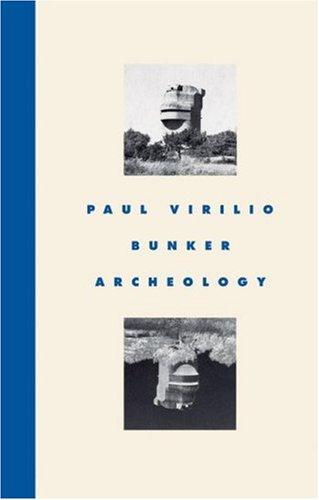
I have known Paul Virilio for a long time as a theorist and thinker, and while I find his ideas a bit wild I also enjoy their artistic sensibility. Until a few weeks ago, I didn't know he was also a visual artist, and this was the main thrust of his career for most of his early life. This book is a blend; it is a documentation of an art project where Virilio travelled Europe's Atlantic coast photographing concrete Nazi bunkers that were designed to be a wall of protection from attacks by sea. Simultaneous to this, it's a written reflection on Nazi military architecture and its role in the Reich's power, and in how this role became obsolete with the invention of the nuclear bomb.
The photographs are incredible. They are black and white, making the bunkers seem extra heavy in the surrounding white sand, where each one …
I have known Paul Virilio for a long time as a theorist and thinker, and while I find his ideas a bit wild I also enjoy their artistic sensibility. Until a few weeks ago, I didn't know he was also a visual artist, and this was the main thrust of his career for most of his early life. This book is a blend; it is a documentation of an art project where Virilio travelled Europe's Atlantic coast photographing concrete Nazi bunkers that were designed to be a wall of protection from attacks by sea. Simultaneous to this, it's a written reflection on Nazi military architecture and its role in the Reich's power, and in how this role became obsolete with the invention of the nuclear bomb.
The photographs are incredible. They are black and white, making the bunkers seem extra heavy in the surrounding white sand, where each one looks so weighty it is almost pushing down into the sea. Originally published in the 1960s, I imagine many of these bizarre, ugly structures are no longer in situ. This is a bit of a pity, because they are also a weighty reminder of an authoritarian military advance, and of how far it travelled almost without impedance. They are a reminder of a military expansion, but also of its banality and waste.
The theory is also fascinating at times, for example when documenting the Nazi architect Albert Speer and his plans for total war. At other times it is a bit muddled, but that's also a process of thinking-with something like wartime architecture. But beyond all this, the book is a prophecy and a reminder – war is entangled with technology and obsolescence. The final words are a quote from Speer during his trial at Nurenberg, where he said that Hitler wasn't a genius, he was just the first person to understand the power of new communications technologies well enough to manipulate people. A timely warning indeed.