Hardcover, 598 pages
English language
Published 1968 by Aldine Press.
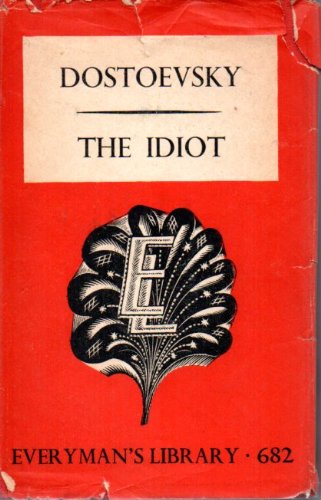
Hardcover, 598 pages
English language
Published 1968 by Aldine Press.
[From the inside flap:] 'The Idiot is not only a very beautiful and a very moving book, but contains its full share of Dostoyevsky's typical and enchanting humour.' Dostoyevsky's international fame rests on the four great novels, The Idiot (1868), Crime and Punishment (1866), The Possessed (1873) and The Brothers Karamazov (1880).
The Idiot was the author's favourite book, and he was nearing fifty when it received publication. Written in Switzerland and Italy the novel is some quarter of a million words in length, and its huge canvas gives 'a multitudinous section of St Petersburg life during several months in the fifties or sixties of last century. Crowds of people of every class throng its pages, all sorts of interwoven episodes and unrelated incidents occur; but dominating the picture is a central theme, which draws many into its orbit … the pitying love of Prince Muishkin, the "idiot", …
[From the inside flap:] 'The Idiot is not only a very beautiful and a very moving book, but contains its full share of Dostoyevsky's typical and enchanting humour.' Dostoyevsky's international fame rests on the four great novels, The Idiot (1868), Crime and Punishment (1866), The Possessed (1873) and The Brothers Karamazov (1880).
The Idiot was the author's favourite book, and he was nearing fifty when it received publication. Written in Switzerland and Italy the novel is some quarter of a million words in length, and its huge canvas gives 'a multitudinous section of St Petersburg life during several months in the fifties or sixties of last century. Crowds of people of every class throng its pages, all sorts of interwoven episodes and unrelated incidents occur; but dominating the picture is a central theme, which draws many into its orbit … the pitying love of Prince Muishkin, the "idiot", for Nastasia Philipovna and his happy love for Aglaya Ivanovna, with all the jealous pan and hate which these emotions, known to both women, engender in them, and their fatal effect on the man who, in the pureness of his soul, is unable to give or to find peace'.
Edward Garnett, in his Everyman Introduction to Dostoyevsky's masterpice, The Brothers Karamazov, put into a few words what most readers fell as the eternal fascination of this author: "Immersed in this book one has the sensation of being carried along in a turbulent flood, engulfed in whirlpools of passionate feeling, whirled along in rapids of thought, caught up and held fast in fresh currents of mystical speculation.' He could stand aside from his book, think upon life, yet always remain perplexed by it. The gulf between dream and reality, mind and the soul. The Brothers Karamazov captures in its rich, intricate pattern of thought and sensation the reader's interests on three separate planes: the plane of the Karamazov family life, the plane of the murder mystery and the metaphysical (2 vols., Nos. 802-3). This and Crime and Punishment (No. 501) represent the author's best known work, and the last named is the only other novel in which Dostoyevsky recalls his actual prison experiences. The sweeping epic, The Possessed, where the author shows the 'devilishness resulting from exaltation of the human will, even in those with the greatest candour of soul', is contained in two volumes, Nos. 861-2.
Poor Folk and The Gambler are paired in No. 711 and represent the early period, in which nevertheless many original touches are revealed. Dostoyevsky had a liking for gambling and The Gambler is considered to be therefore partly autobiographical.