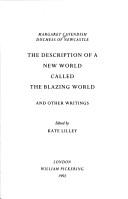

When I was a kid, I had an old copy of The Three Musketeers, an english translation, and it was loaded with verbose, repetitive phrases that didn't really add any meaning. Kid Me decided that this was just how old-timey people talked (and wrote). Later I read a french edition and decided that the translation I had gotten was just overly literal. Now, having read "The description of a new world, called the Blazing-World, and other writings", I'm back to thinking that Kid Me had the right of it.
I read this because it was proposed as potentially the first science fiction novel, and while it's kind of interesting in a historic and linguistic way, it falls pretty solidly in the "I read this so you don't have to" category. In modern terms, I'd file it under fantasy - a noblewoman gets kidnapped and then isekai'd to another world, …
When I was a kid, I had an old copy of The Three Musketeers, an english translation, and it was loaded with verbose, repetitive phrases that didn't really add any meaning. Kid Me decided that this was just how old-timey people talked (and wrote). Later I read a french edition and decided that the translation I had gotten was just overly literal. Now, having read "The description of a new world, called the Blazing-World, and other writings", I'm back to thinking that Kid Me had the right of it.
I read this because it was proposed as potentially the first science fiction novel, and while it's kind of interesting in a historic and linguistic way, it falls pretty solidly in the "I read this so you don't have to" category. In modern terms, I'd file it under fantasy - a noblewoman gets kidnapped and then isekai'd to another world, of which she immediately becomes empress. She spends about half the book grilling her new followers, various types of anthropomorphic animals, about how things work on their world, and they reply with reams of pseudoscientific waffle. She also becomes "Platonic Lovers" with the literal soul of the author. It is nonsensical, extremely verbose, and rambling.